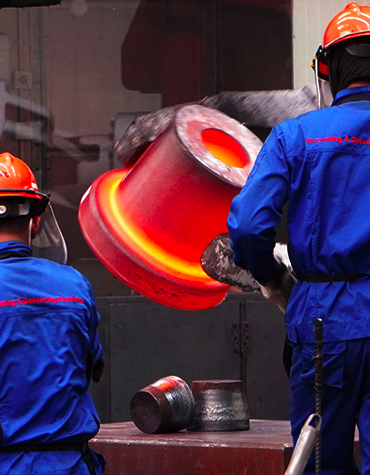
The forging process begins by heating the raw material to the specified forging temperature in a natural gas furnace. The heating temperature is determined based on the material grade and process card requirements to ensure the material reaches optimal plasticity for deformation. Proper temperature control at this stage is essential to prevent metallurgical defects and to ensure uniform internal structure.
Once the required temperature is achieved, the heated material is transferred to the forging area. The forging operation is carried out using a hydraulic electric hammer, supported by a manipulator and a material handling machine. These systems work in coordination to ensure controlled deformation, dimensional accuracy, and operator safety throughout the process.
All forging activities are performed strictly in accordance with the approved process card. The process card defines critical parameters such as forging sequence, reduction ratio, deformation steps, and dimensional targets. Adherence to this documented procedure ensures consistency, repeatability, and compliance with customer specifications.
During forging, temperature monitoring is continuously conducted using a handheld infrared thermometer (Fluke). This device allows real-time surface temperature verification to ensure the material remains within the acceptable forging temperature range. Maintaining proper temperature during deformation is crucial to achieving the desired mechanical properties, grain refinement, and structural integrity.
Through controlled heating, systematic forging operations, and continuous temperature monitoring, we ensure that each forged component meets stringent quality standards, maintains full traceability, and achieves the required mechanical and metallurgical performance.